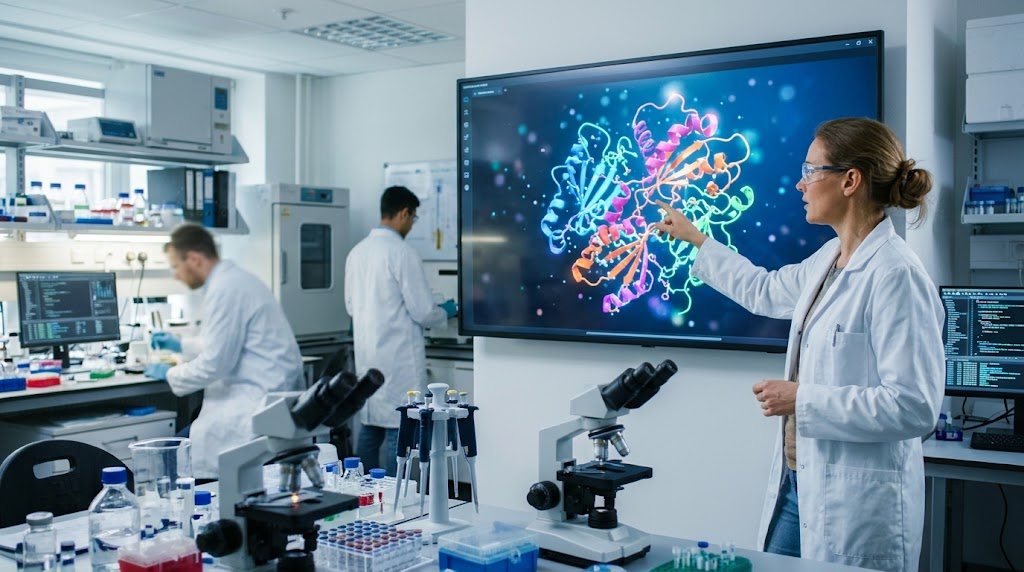
AlphaFold earned a Nobel Prize by predicting the shapes of proteins. The same science now powers a new generation of drug discovery, and the first AI-designed candidates are showing results in the clinic.
In October 2024, the Nobel Prize in Chemistry went in part to two scientists at Google DeepMind, Demis Hassabis and John Jumper, for AlphaFold, an AI system that predicts a protein's 3D structure from its amino acid sequence. They shared the prize with David Baker, who was honored for computational protein design.
The award recognized a scientific milestone. It also marked the start of a commercial one. Biology is becoming an information science, and the companies building on that shift are compressing the early stages of drug discovery from years into months.
Why protein structure matters
Proteins carry out most of the work in living cells, and their function depends on their shape. Knowing that shape tells researchers where a drug molecule might attach and how it could change the protein's behavior.
For decades, determining a single structure could take years of laboratory work. AlphaFold changed the pace. In 2022, Google DeepMind released predicted structures for more than 200 million proteins through a free public database, giving every lab in the world a head start.
A tool used by millions of scientists
The adoption numbers tell the story. In a November 2025 review marking five years of impact, Google DeepMind reported that:
- More than 3 million researchers in over 190 countries have used the AlphaFold Protein Structure Database, including more than 1 million in low- and middle-income countries.
- AlphaFold has been cited in more than 35,000 papers.
- More than 30% of AlphaFold-related research focuses on disease.
- An independent analysis by the Innovation Growth Lab found that researchers using AlphaFold 2 submitted over 40% more novel experimental protein structures, and related research was twice as likely to be cited in clinical articles.
The discoveries span medicine and nature. Researchers used AlphaFold 2 to help reveal the cage-like structure of apolipoprotein B100, the central protein in LDL cholesterol, a finding with direct relevance to heart disease. Others have used it to study immunity in honeybees and how plants sense changes in their environment.
AlphaFold 3 maps the molecules of life
In May 2024, Google DeepMind and Isomorphic Labs introduced AlphaFold 3, which predicts not only protein structures but also how proteins interact with DNA, RNA, ligands and other molecules. For interactions between proteins and other molecule types, the team reported at least a 50% improvement over existing methods. For some important categories, prediction accuracy doubled.
That capability speaks directly to medicine, since many drugs work by binding to a specific protein. Google DeepMind also launched AlphaFold Server, a free tool for non-commercial research that lets scientists model complex structures without specialized computing resources. It has since produced more than 8 million structure and interaction predictions.
A wider circle of discovery
AlphaFold 3 also performed well on PoseBusters, a standard benchmark for how drug-like molecules bind to proteins. Google DeepMind reported that the model was 50% more accurate than the best traditional methods, without needing any structural input. In November 2024, the team released the AlphaFold 3 model code and weights for academic use, widening access further.
The effect on the research community has been broad. The original AlphaFold 2 paper was published in 2021, and more than 200,000 papers have incorporated elements of AlphaFold 2 into their methods.
The tool has also opened science to new talent. Google DeepMind highlights two undergraduates in Turkey, Alper and Taner Karagöl, who taught themselves structural biology through AlphaFold tutorials and have since published 15 research papers. When expert tools become easy to use, the pool of people who can contribute to discovery grows.
Isomorphic Labs builds a drug design engine
Isomorphic Labs, founded in 2021 and led by Demis Hassabis, is building on AlphaFold to design new medicines. In January 2024, it announced two research collaborations, one with Eli Lilly and one with Novartis, both focused on small-molecule therapeutics across multiple targets. Together the partnerships have a potential value of nearly $3 billion to Isomorphic.
In March 2025, Isomorphic raised $600 million in its first external funding round, led by Thrive Capital with participation from GV and follow-on capital from Alphabet. The company said the funding would advance its AI drug design engine and move its therapeutic programs into clinical testing.
Isomorphic is also applying AlphaFold 3 to its own internal drug design projects alongside its partner work. The combination gives the company two engines of progress: shared programs with established drugmakers and a growing pipeline of its own.
The model is instructive. A research breakthrough became a platform, the platform attracted large pharmaceutical partners and those partnerships created a path from prediction to patients.
AI-designed candidates reach patients
The broader field is already producing clinical evidence. In June 2025, Insilico Medicine published Phase IIa results in Nature Medicine for rentosertib, a drug candidate for idiopathic pulmonary fibrosis that was discovered and designed with an AI approach.
In the 12-week trial of 71 patients, the group receiving the highest dose showed a mean gain in lung capacity, measured as forced vital capacity, of 98.4 mL. The placebo group showed a mean change of minus 20.3 mL.
The trial built on earlier groundwork. Insilico published rentosertib's discovery, design and Phase I results in Nature Biotechnology in March 2024, documenting the AI process from target identification through to the molecule itself.
Speed is the second signal. Insilico reports that across 22 preclinical candidates nominated between 2021 and 2024, the average time from project start to candidate nomination was 12 to 18 months. The typical range for traditional discovery is 2.5 to 4 years.
Lessons for enterprise leaders
Biotech offers a useful model for any industry adopting AI:
- Open foundations help everyone move faster. Making AlphaFold predictions freely available multiplied their impact across millions of scientists.
- Partnerships accelerate progress. Isomorphic pairs its AI engine with the development expertise of large pharmaceutical companies.
- Early speed compounds. Shortening discovery frees teams to explore more ideas and more targets.
- Measurable outcomes build confidence. Peer-reviewed results in journals such as Nature Medicine show progress in concrete terms.
Lessons for every industry
The path from a Nobel-winning model to AI-designed candidates in clinical trials took only a few years. That pace is a signal for every sector: when AI addresses a core scientific or operational bottleneck, it can open entirely new categories of work.
For executives in life sciences, healthcare, chemicals and materials, the opportunity is to identify where structure, prediction or simulation slows teams down today, and to partner with the groups building tools that remove those bottlenecks. For everyone else, AlphaFold is a compelling case study in what patient, long-term research can deliver, and a reminder that the next breakthrough may come from pairing deep domain expertise with AI.
Sources
- Google Blog, "Google DeepMind's Demis Hassabis & John Jumper awarded Nobel Prize in Chemistry," October 9, 2024.
- Google DeepMind, "AlphaFold: Five Years of Impact," November 25, 2025.
- Google Blog, "AlphaFold 3 predicts the structure and interactions of all of life's molecules," May 8, 2024.
- Isomorphic Labs, "Isomorphic Labs kicks off 2024 with two pharmaceutical collaborations," January 7, 2024.
- Isomorphic Labs, "Isomorphic Labs announces $600m external investment round," March 31, 2025.
- EurekAlert!, "Insilico Medicine announces Nature Medicine publication of Phase IIa results evaluating rentosertib," June 2025.