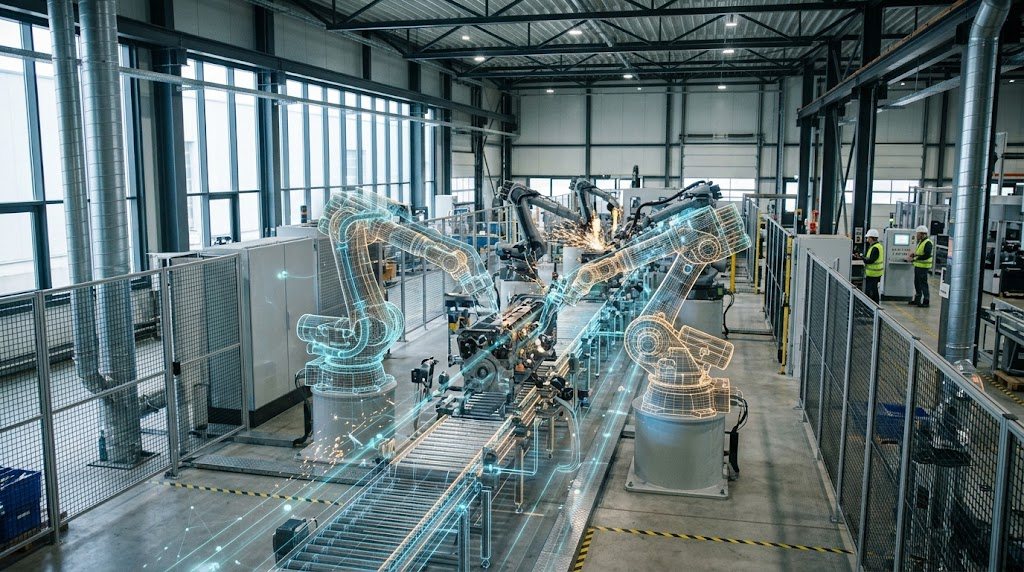
Leading manufacturers now design, test and refine entire factories in simulation before construction begins. The result is faster launches, smoother ramp-ups and better plants.
The most advanced factories in the world are now built twice: first in software, as a physically accurate digital twin, and then in steel and concrete. The virtual version lets engineers test layouts, robot paths and material flows long before construction crews arrive.
What began as a showcase concept is now standard practice at some of the largest manufacturers. BMW, Foxconn, Toyota, TSMC, PepsiCo and others are using NVIDIA Omniverse and partner software from Siemens to plan, validate and improve their operations in simulation first.
What an industrial digital twin is
An industrial digital twin is a live, physically accurate 3D model of a product, process or plant. It combines engineering data, simulation and real-world operating data so teams can see how a change will play out before they make it.
NVIDIA Omniverse provides much of the underlying simulation technology, built on the open OpenUSD format so that tools from different vendors can share one model. That openness matters. A single factory twin may bring together data from Siemens, Autodesk and Bentley Systems software, as BMW's does.
BMW's virtual-first factory in Debrecen
BMW Group offers the clearest example of the approach at scale. At NVIDIA GTC in March 2023, BMW board member Milan Nedeljković joined NVIDIA CEO Jensen Huang to open the company's first entirely virtual factory: the future plant in Debrecen, Hungary. Virtual planning began more than two years before series production.
To make that possible, BMW had scanned more than 7 million square meters of indoor production space and more than 15 million square meters of outdoor space across its plants. Teams built a custom application, Factory Explorer, on Omniverse to bring all that data into one place. Nedeljković said at the time that virtualization and artificial intelligence were accelerating and refining BMW's planning.
The twin also connects the tools BMW's planners already use, including Siemens Process Simulate, Autodesk Revit and Bentley Systems MicroStation. Teams in different countries can walk through the same virtual hall, review a proposed change together and agree on it before anything moves on the real floor.
The plant officially opened on September 29, 2025. BMW reports that the placement and processes of nearly 1,000 industrial robots in the body shop were simulated in detail in advance. Debrecen is also the first BMW Group car plant to run entirely on renewable electricity in normal operation, and it builds the new BMW iX3, the first Neue Klasse model.
Foxconn and the next generation of AI factories
Foxconn is applying the same method to the facilities that build AI infrastructure itself. At GTC Washington, D.C., in October 2025, NVIDIA announced that Foxconn had used Omniverse tools to design, simulate and optimize a new 242,287-square-foot facility in Houston, Texas, that will manufacture NVIDIA AI systems.
According to an NVIDIA case study, Foxconn engineers use a Siemens digital twin stack built on Omniverse libraries to validate systems virtually before construction. Thermal simulations run up to 150 times faster with NVIDIA PhysicsNeMo, returning results in minutes rather than hours. Foxconn estimates that factory setup and planning time can be cut by about 50%.
Production lines designed this way can also be copied from one site to another. That makes it faster to bring a new plant online and scale a proven line across regions.
Siemens brings the twin to every engineer
Siemens and NVIDIA have steadily deepened their partnership. At CES in January 2026, Siemens announced Digital Twin Composer, which combines Siemens digital twin software, simulations built with Omniverse libraries and real-time engineering data. Users can place a product, process or plant in a 3D scene and move through time to see the effect of a change.
The two companies also said they are building an Industrial AI Operating System for designing and running physical systems, starting with the Siemens Electronics Factory in Erlangen, Germany, as the first blueprint.
Siemens reported that PepsiCo, using this approach, identified up to 90% of potential issues before making physical changes, increased throughput by 20% on initial deployment and achieved nearly 100% design validation. "Industrial AI is no longer a feature; it's a force that will reshape the next century," said Siemens CEO Roland Busch.
A growing roster of builders
NVIDIA's October 2025 announcement listed a wide set of manufacturers building factory twins with Omniverse:
- Toyota is creating a digital twin of its Georgetown, Kentucky, facility.
- TSMC is using Omniverse to accelerate fab design and construction at its Phoenix, Arizona, site.
- Caterpillar is building twins of its factories and supply chains for predictive maintenance and dynamic scheduling, and is using NVIDIA cuOpt to optimize supply chain performance.
- Belden uses Accenture's Physical AI Orchestrator, which combines Omniverse libraries with NVIDIA Metropolis, for virtual safety fences that monitor hazardous zones in real time.
- Lucid Motors is using factory twins for real-time planning and optimization.
- Wistron uses Omniverse for digital testing and validation of systems assembled at its Fort Worth, Texas, facility.
NVIDIA also expanded its Mega Omniverse Blueprint, originally created to simulate fleets of industrial robots, to cover full factory digital twins. Siemens became the first company to build digital twin software that supports it, and FANUC and Foxconn's Fii were among the first robot makers to offer OpenUSD-based digital twins of their machines.
Why simulation-first planning pays off
The appeal of the method is simple. Every decision made in the twin is a decision that does not have to be revisited on the factory floor. Engineers can try dozens of layouts in the time it once took to evaluate one, and every team works from the same shared model.
Access is widening as well. Siemens said Digital Twin Composer would be available on the Siemens Xcelerator Marketplace in mid-2026, and the company is committing hundreds of industrial AI experts to its work with NVIDIA. As these tools become easier to adopt, simulation-first planning is moving from flagship plants to everyday projects.
The benefits also continue after launch. A twin connected to live data becomes a planning tool for each new product, shift pattern or line upgrade, so the plant keeps improving long after opening day.
Bringing simulation to your operations
Digital twins have moved from showcase to standard practice for new plants and major upgrades. The lesson from BMW, Foxconn and PepsiCo is that the biggest gains come early, when a change is as easy as moving an object on a screen.
For enterprise leaders, a few practical starting points:
- Begin with one line or one facility where a planned change is already on the calendar.
- Gather the data you already have, from CAD files to 3D scans, into an open format.
- Bring planners, engineers and operators into the same model so decisions happen together.
- Measure the impact in throughput, issues caught early and time to launch.
The companies leading this shift are proving a simple idea: when you can test the future in simulation, you can build it with confidence.
Sources
- NVIDIA Blog, "BMW Group Starts Global Rollout of NVIDIA Omniverse," March 21, 2023.
- Automotive World, "BMW Group at NVIDIA GTC: Virtual production under way in future plant Debrecen," March 21, 2023.
- BMW Group PressClub, "BMW Group's newest, most innovative production site officially opens in Debrecen," September 29, 2025.
- NVIDIA Newsroom, "NVIDIA and US Manufacturing and Robotics Leaders Drive America's Reindustrialization With Physical AI," October 28, 2025.
- NVIDIA, "Foxconn Develops Physical AI-Enabled Smart Factories with Digital Twins," case study, February 2026.
- Siemens, "Siemens unveils technologies to accelerate the industrial AI revolution at CES 2026," January 6, 2026.